Running Tests for OHIF
We introduce here various test types that is available for OHIF, and how to run each test in order to make sure your contribution hasn't broken any existing functionalities. Idea and philosophy of each testing category is discussed in the second part of this page.
Unit test#
To run the unit test:
yarn run test:unit:ciNote: You should have already installed all the packages with yarn install.
Running unit test will generate a report at the end showing the successful and unsuccessful tests with detailed explanations.
End-to-end test#
For running the OHIF e2e test you need to run the following steps:
Create a mini-pacs for OHIF to access the images for testing. We download and run our lightweight implementation which provides a collection of DICOM studies (source code).
docker run -p 5985:5985 -p 5984:5984 -e USE_POUCHDB=true -e DB_SERVER=http://0.0.0.0 ohif/viewer-testdata:0.1-testSuccessful execution should be

Open a new terminal, navigate to the OHIF project, and run OHIF with the dicom-server config
APP_CONFIG=config/dicomweb-server.js yarn startYou should be able to see test studies in the study list
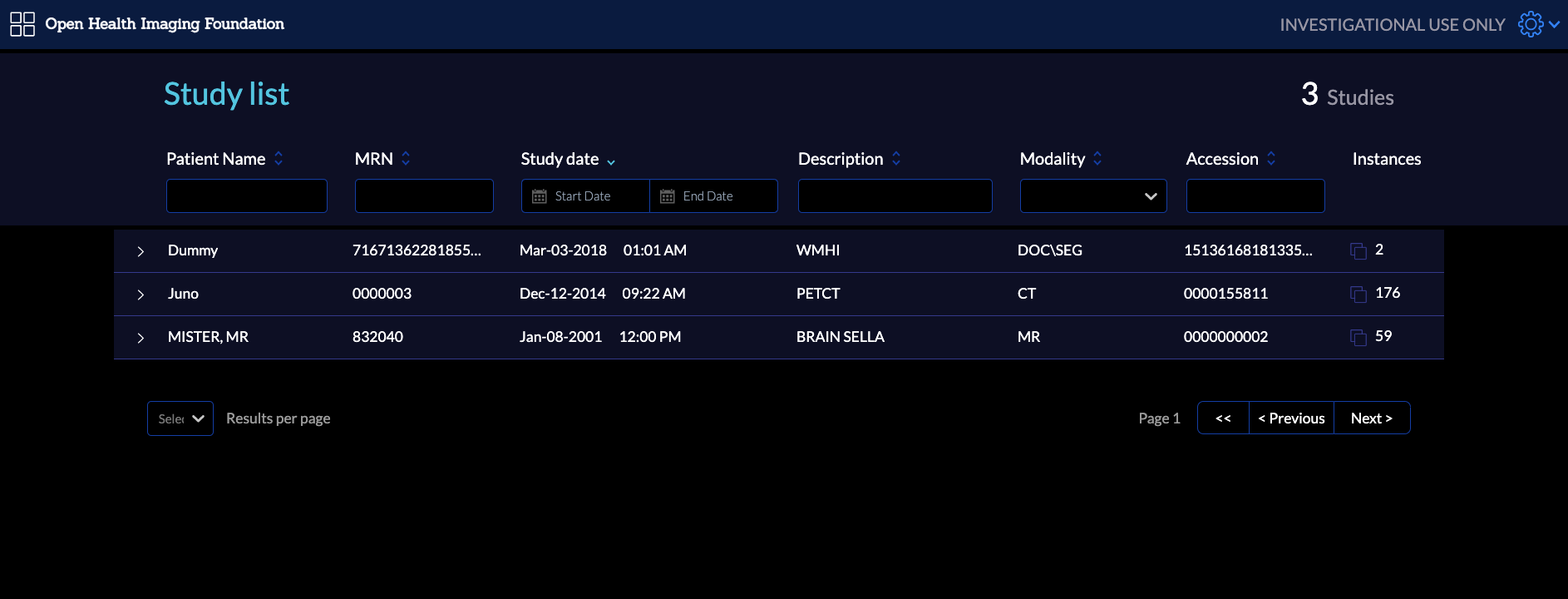
Open a new terminal inside the OHIF project, and run the e2e cypress test
yarn run test:e2eYou should be able to see the cypress window open
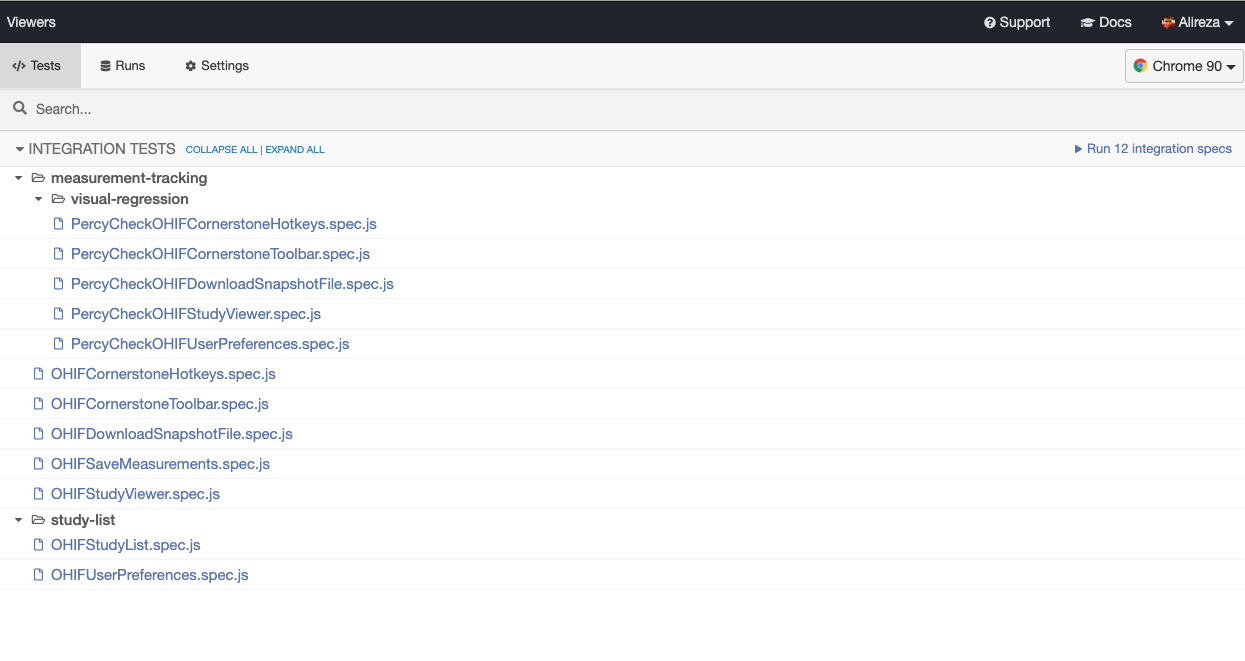
Run the tests by clicking on the
Run #number integration tests.A new window will open and you will see e2e tests being executed one after each other.
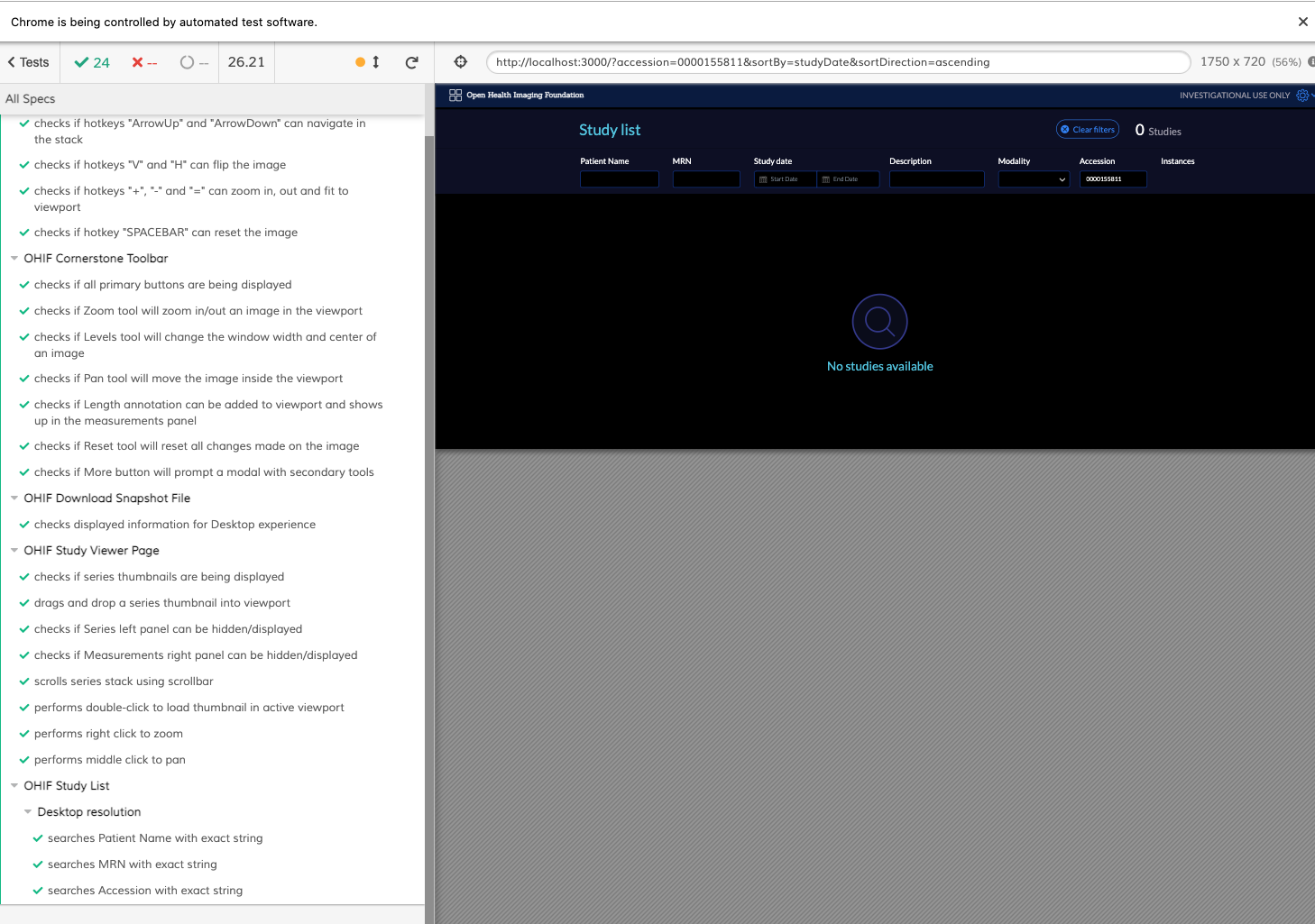
Testing Philosophy#
Testing is an opinionated topic. Here is a rough overview of our testing philosophy. See something you want to discuss or think should be changed? Open a PR and let's discuss.
You're an engineer. You know how to write code, and writing tests isn't all that different. But do you know why we write tests? Do you know when to write one, or what kind of test to write? How do you know if a test is a "good" test? This document's goal is to give you the tools you need to make those determinations.
Okay. So why do we write tests? To increase our... CONFIDENCE
- If I do a large refactor, does everything still work?
- If I changed some critical piece of code, is it safe to push to production?
Gaining the confidence we need to answer these questions after every change is costly. Good tests allow us to answer them without manual regression testing. What and how we choose to test to increase that confidence is nuanced.
Further Reading: Kinds of Tests#
Test's buy us confidence, but not all tests are created equal. Each kind of test has a different cost to write and maintain. An expensive test is worth it if it gives us confidence that a payment is processed, but it may not be the best choice for asserting an element's border color.
| Test Type | Example | Speed | Cost |
|---|---|---|---|
| Static | addNums(1, '2') called with string, expected int. | 🚀 Instant | 💸 |
| Unit | addNums(1, 2) returns expected result 3 | ✈️ Fast | 💸💸 |
| Integration | Clicking "Sign In", navigates to the dashboard (mocked network requests) | 🏃♂️ Okay | 💸💸💸 |
| End-to-end | Clicking "Sign In", navigates to the dashboard (no mocks) | 🐢 Slow | 💸💸💸💸 |
- 🚀 Speed: How quickly tests run
- 💸 Cost: Time to write, and to debug when broken (more points of failure)
Static Code Analysis#
Modern tooling gives us this "for free". It can catch invalid regular expressions, unused variables, and guarantee we're calling methods/functions with the expected paramater types.
Example Tooling:
Unit Tests#
The building blocks of our libraries and applications. For these, you'll often be testing a single function or method. Conceptually, this equates to:
Pure Function Test:
- If I call
sum(2, 2), I expect the output to be4
Side Effect Test:
- If I call
resetViewport(viewport), I expectcornerstone.resetto be called withviewport
When to use#
Anything that is exposed as public API should have unit tests.
When to avoid#
You're actually testing implementation details. You're testing implementation details if:
- Your test does something that the consumer of your code would never do.
- IE. Using a private function
- A refactor can break your tests
Integration Tests#
We write integration tests to gain confidence that several units work together. Generally, we want to mock as little as possible for these tests. In practice, this means only mocking network requests.
End-to-End Tests#
These are the most expensive tests to write and maintain. Largely because, when they fail, they have the largest number of potential points of failure. So why do we write them? Because they also buy us the most confidence.
When to use#
Mission critical features and functionality, or to cover a large breadth of
functionality until unit tests catch up. Unsure if we should have a test for
feature X or scenario Y? Open an issue and let's discuss.
General#
- Assert(js) Conf 2018 Talks
- Write tests. Not too many. Mostly integration. - Kent C. Dodds
- I see your point, but… - Gleb Bahmutov
- Static vs Unit vs Integration vs E2E Testing - Kent C. Dodds (Blog)
End-to-end Testing w/ Cypress#
- Getting Started
- Be sure to check out
Getting StartedandCore Concepts
- Be sure to check out
- Best Practices
- Example Recipes